Bringing Back Paradise
A paper for the club by Will Parish
November 12, 2018
I- The Facts
I was not prepared for how the death of some trees would derail my emotional life. When Julie and I found the 1,000-acre Bohemian Ranch north of Occidental in the summer of 2010, we fell in love with it. A developer wanted to turn it into a maze of mansions and we set about trying to purchase it and protect it. To us it was a paradise, meant to be kept pristine. Redwood forests, 3 creeks, oak groves, meadows, and hilly terrain with breathtaking views. After 15 months of negotiating, we succeeded. We wanted to build a wilderness retreat on the very southerly edge of the land to provide a comfortable meeting place both for our family and for groups who want to learn from the spiritual land.
Over four years ago, on July 17, 2014, while enjoying the farmhouse on Martha’s Vineyard that Julie and I rent every summer, I called our property manager at Bohemia. After much consternation, I finally decided to approve the plan to chainsaw three trees at the house site to allow for a better landscaping plan.
Well, my decision has haunted me almost daily, unexpectedly invading my orderly emotional world, causing me to feel depressed, anxious and regretful.
This paper will explore my reaction to killing the trees. I will search for how to live with my mistake. There’s a disconnect about these deaths compared to the far more significant deaths of the friends I’ve lost to disease, suicide and accidents about which I haven’t felt the need to write and figure out. I think it’s because the deaths of Ben, Spots, Doug, Jake, Bob, and Oliver did not produce an unexpected upwelling of emotion. Nor were their deaths my doing. The human deaths did not elicit a mystical curiosity of wonder and awe. But cutting down those trees revealed a hidden emotional world behind the world I thought I knew.
In August of 2014, Julie and I excitedly hiked up through the woods to the site where our paradise retreat would be built, nestled into the grove of trees. Our pace quickened as we topped the crest of the hill. All of a sudden, I was nearly blinded by the glaring sunlight. I frantically looked for the grove. Where was it? That grove with tall firs living alongside the ancient oaks was gone! Our house site was wrecked! Somebody’s head was going to roll I was so angry. I swore that the logger had cut down many more trees than just the three I had approved.
But then I saw the remains. Two small piles of long fir logs, and one pile of gigantic logs. I went over to the hugest log and measured it with my body: Six feet in diameter. How could I have done such a thing…? Julie consoled me,
saying, hey, they weren’t oaks, they were just volunteer firs and our house site is still beautiful.
Four months after the trees’ deaths, Julie and I were walking around the house site with members from our architect firm. The youngest member, Lucas, looked at the gigantic logs, and exclaimed, "Wow. That big one must've been 500 years old!"
I choked and realized I had not dared to count the rings. Grief gripped me as I continued walking and thought back to the day I had reviewed our landscape architect’s rendering. She had put a big "X" over the Big Douglas Fir, since it was smack in the middle of our view corridor and plans for a beautiful meadow. She had put a smaller "x" over the two other firs, indicating a lesser degree of intrusiveness.
As the group continued on, I lingered behind. I shivered as I imagined the tremors of terror that huge fir must have felt, as the chain saw sliced into its skin, deeper, into its core until it could no longer stand upright and slowly tipped over, picking up speed, and striking the ground with a thunderous roar, its huge girth bouncing up once, then slamming down a final time, crumpling and snapping its branches to pieces.
I never noticed until they were all gone how that enormous Douglas Fir formed the apex of a triangle with the other two smaller firs. Together, they had anchored the oak grove. One day, I dared to count the rings of the big fir. One hundred fifty. Well, that’s better than 500 but way more than the forty or so I was hoping for.
These three Doug Firs had been sentinels reaching to the sky, straight up. They contrasted poetically with the scraggly twisted arms of the old oaks. Mr Gigantica first took root a century and a half ago, and had been looking out over the ravine until I ended its life. The smaller siblings voluntarily popped up in the 1960's and had been standing at the edge of the oak grove, protecting it. All dead.
Back in 1868, the two smaller trees hadn’t even germinated, but the Gigantic fir had started its life as a small sapling. In the early 1900s, all the trees around it were felled for lumber as part of the Northern California Timber Rush. Loggers cut down practically every single tree, dragged the trunks down long skid roads, and loaded them onto rail cars destined for milling in Duncan Mills and other logging towns.
The loggers had spared this lone fir. Why hadn’t they taken it along with the others? Maybe it was too small back then to have bothered with. Or, was there one logger who advocated for it, and persuaded the others to leave it alone so that it could become as mighty as the ones they were cutting down, a reminder to future generations of the grandeur of the mighty fir?
The Doug Fir is maligned as a “volunteer”. They are not liked by hardwood forest advocates since they outgrow the oak trees, shading them and ultimately causing them to die. The Doug Fir reigns supreme as the climax species in the California forests in this part of the state.
When we first bought the property in 2011, and drove to the hilltop, I marveled at the gargantuan tree's girth. In the weeks and months that followed, I loved sitting next to it. It gave me joy just to be in its presence. I had no idea that 3 years later we would pick this exact site, out of the one thousand acres, for our Longhouse.
I know why the landscape architect "Xed" it out of the plan. It was ugly. Big, bold, unabashedly shaggy with branches spewing out every which way, many broken. But all that ugliness started 20 feet above the ground. Below that, the tree was perfectly gorgeous. Its bark was tight and guttered as any fir you've ever seen, home to countless life forms from lichen to insects, and grubs for the wood peckers and brown creepers. You couldn't reach all the way around it with 6 people.
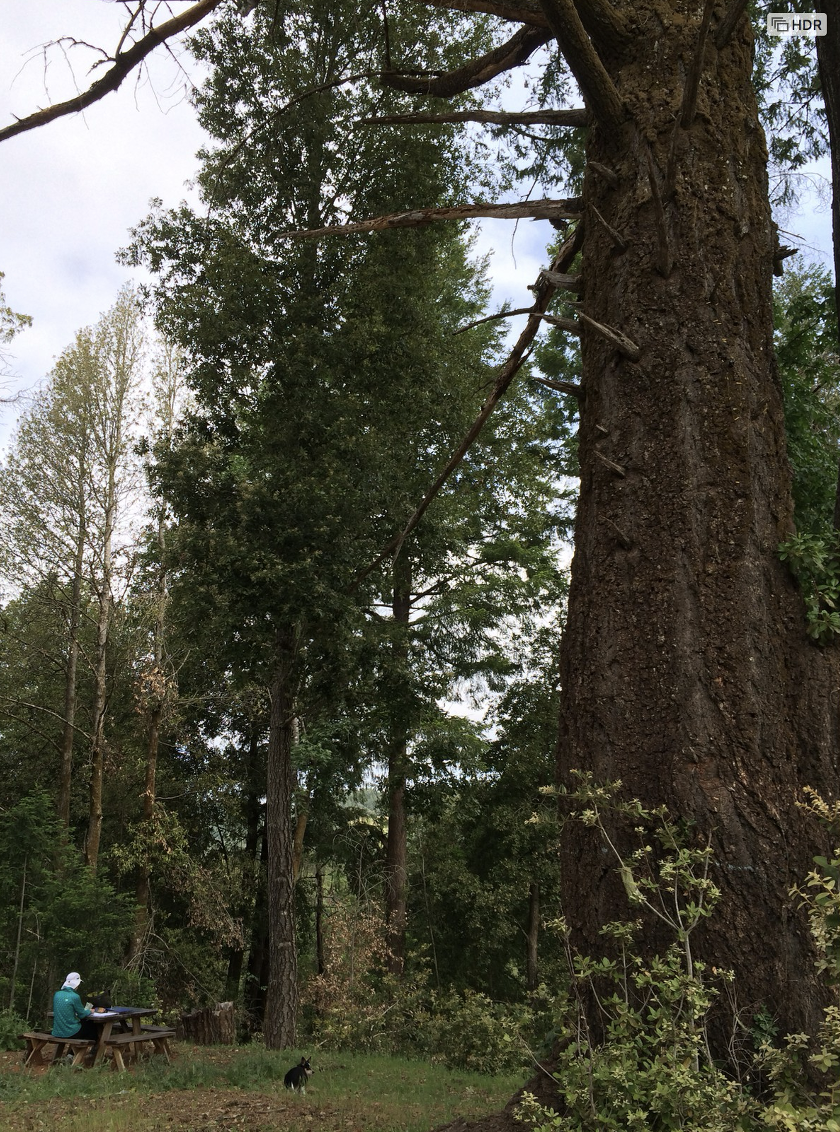
The Big Fir, Mr Gigantic
II- The psychology
Even though there were three trees cut down, my strongest connection was to the 150-year old gigantic fir. So, that will be my main focus, though I’ll reference the other two smaller firs from time to time.
In order to cope with my feelings of stupidity and loss, I told myself a story that is at least in part true. The prior owner had done aggressive bulldozing in order to level the top of the hill. The blade so damaged the roots that the Big Fir tree was going to die at some unpredictable time, and that would create danger and chaos for the people and structures below. Goddamn Chuck Butler. There, that feels better. Finally somebody I can blame.
That blaming approach has not worked. Other approaches have not worked, like trying to forget about it, telling myself to stop regretting it. Move on! Adjusting to my mother’s death was easier than dealing with the loss of these trees.
To deal with my aguish, I sought counseling. Think of that! Counseling to help me deal with cutting down a few trees. If my World-War-Two-Marine-Corps- Captain father ever knew that I needed counseling for this, how he would belittle me.
A good friend of mine, Tom, is a Jungian analyst. I told him my sad story, and the first thing he said was, "It’s good that you can’t shake the loss of the trees. This experience takes you from your rational mind to your deeper feelings that your mind can’t control." Uh oh” I feared how many sessions he would want me to sign up for! Tom convinced me to turn this loss into a learning experience. To live through it and not deny it.
So, I began the journey.
The counseling has produced useful insights. I had no idea about the importance of trees as symbols throughout mankind's history. Connecting to the tree as an ever-present symbol in thousands of cultures has helped me understand my motivations and blind spots. It’s helped me integrate my emotional and spiritual worlds.
My traumatic reaction came out of the blue. It didn't start with a thought. This whole inquiry got triggered, profoundly and unexpectedly from an action that was just an architectural decision. The mark of an “X” on some drawings.
I didn't know enough to talk the others out of cutting down the trees, because I had failed to see the deep meaning that the trees had to me. Tom helped me see that my anguish was over having violated Mother Earth, and my desire to be expiated from the guilt of having desecrated nature. My action injured my deepest self. It disconnected my heaven and earth.
What’s worse, is that this wasn’t the first time! My exploring with Tom brought forth that when I was ten years old, I had cut down some saplings playing with a small hatchet. When the sunlight poured in, I cried, realizing after the fact, that I had destroyed my little forest hideaway.
Reacting to killing the trees has brought to light the psychological root of my life’s purpose for the last thirty years: using my resources to protect nature from
the stupidity and unknowingness of humans. So how on earth could I have done this?
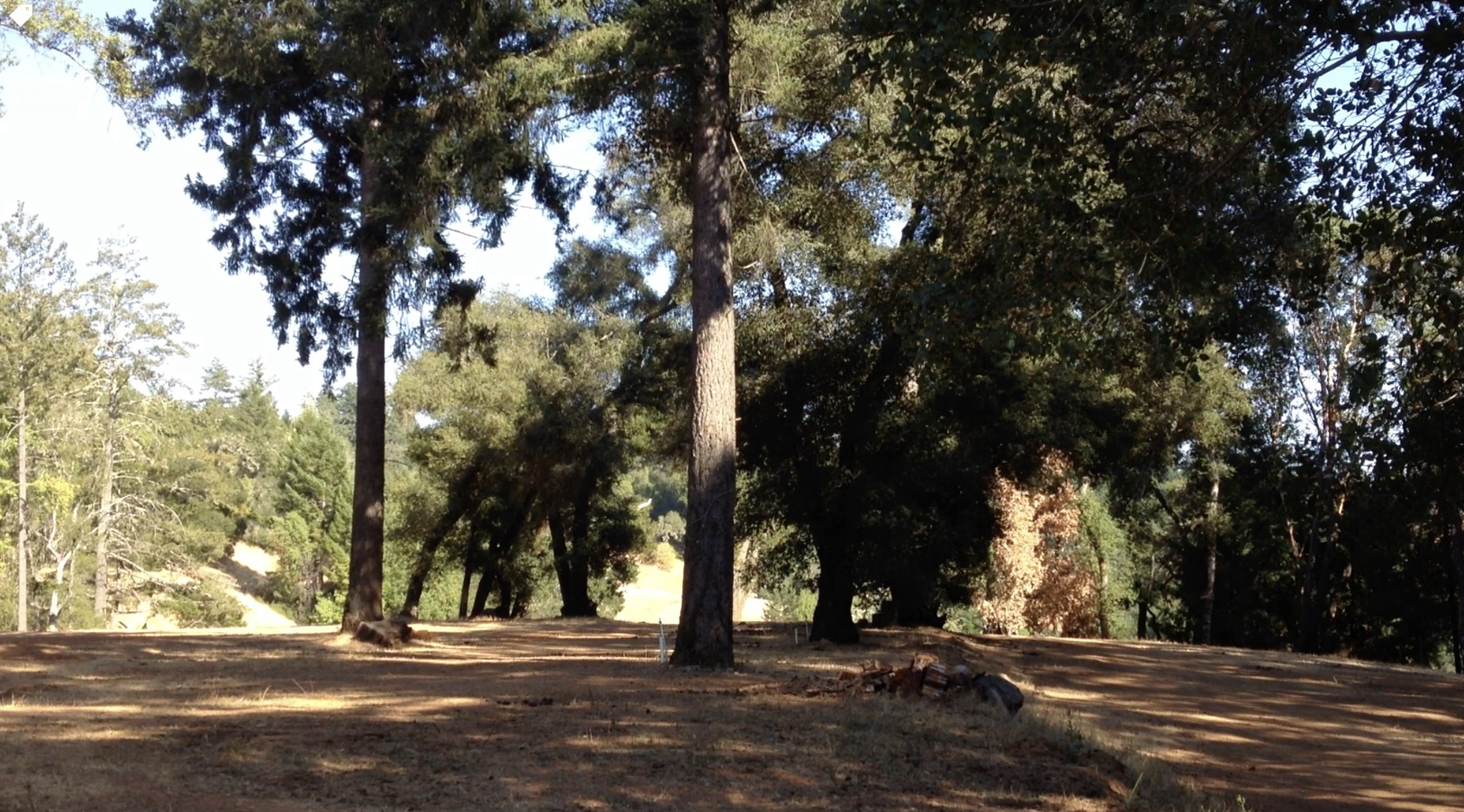
The two volunteer firs
Paradise Lost
The destruction of the trees broke the spell of the paradise. I inadvertently introduced my own nature into the environment and the result appalled me. My own action kicked me out of the garden that is Bohemia. How often do we feel like we’ve lost paradise and how often do we name it?
In John Milton’s epic poem, Paradise Lost, consciousness only comes through this type of rupture. There’s a loss and an awakening. I didn't know that losing those trees would result in my feeling like I had ruptured my connection to the place. There was something deep in my core, and I witnessed myself breaking it. And that rupture has revealed to me a deeper connection to my own life purpose.
As Milton wrote:
“Thus with the Year
Seasons return, but not to me returns
Day, or the sweet approach of Ev’n or Morn,
Or sight of vernal bloom, or Summers Rose,
Or flocks, or herds, or human face divine;
But cloud in stead, and ever-during dark
Surrounds me, from the chearful waies of men
Cut off, and for the book of knowledg fair
Presented with a Universal blanc
Of Natures works to mee expung’d and ras’d,
And wisdome at one entrance quite shut out.”
World Tree
Another layer of thinking about all this is the Gigantic Fir as the world tree. I didn't cut down just any ole tree, but the tree that connected the land to the world and me. My sensitivity is non-rational. My grief is beyond rational. Deep down, I injured the spirit of connectedness of man and nature.
My reasons for establishing Ten Strands was to teach at the scale of the entire education system, that we must protect the environment. Here I am, trying to remedy the blight of mankind, and I’ve participated in it. This whole tree experience has created a new awakening that didn’t come at the beginning of my career, and has become the most intimate experience behind my environmental work.
Violating Mother Earth
I have learned, that I, like anybody else, am capable of causing harm to the environment. And I can also cause pain to that which I love. In trying to make peace with my deed, I must admit that I did damage to something I hold as sacred. That process of acceptance is humanizing and humbling.
So, to sum up the psychology of all this. I didn't know it at the time, but the Big Fir was a reference point. I inadvertently destroyed it. I participated in the very thing that I have spent my life preventing: A disregard for the natural world. And now I must find a way to live in peace with my mistake.
Macho Macho Man
Cutting down the firs happened during a period in my professional environmental education life where I was experiencing a great deal of pride in my accomplishments. I was motivating leaders in Sacramento to embrace the idea of environment-based education for all 6,200,000 students in California’s education system. Also, I had just accomplished a feat at Bohemia. I had defied all my advisors and achieved approval for a stream restoration project in under 6 months. How? I knew the person in Congress who held the key, and called him.
Hubris got a grip on me. I ignored the potentially negative emotional responses to the outcome of my actions. I had a blind spot that often accompanies hubris. My blind spot was not knowing how important those trees would become to me after they were gone. I'm upset at myself for not foreseeing the misery my decision would cause in me.
My best buddy and I have been doing annual retreats ever since completing a trip around the world after college. On a recent one, we decided to camp at Bohemia. I revealed my sensitivity to trees, how I form relationships with certain ones. I admitted my anguish over cutting down the oldest tree at Bohemia. My friend said my relationship with trees is unusual and I should own it.
He told me to make some artful expression about what trees mean to me. "Take 15 minutes, right now," he suggested.
So, I did, and here it is:
To me
Trees are playful, soulful, mournful, wise and somber connections To our ancestors and our descendants.
They transcend time, outlive humans, corporations, political parties, Kings’ reigns, regimes, even countries.
They are the perfect being. Altruistic.
They not only provide food for themselves but are host to countless other creatures.
Their shade cools. Their leaves oxygenate.
Their roots keep soil on mountains.
Their mycelium nurtures micro-organisms that in turn help the tree. They cooperate for light.
Even in death they nurture by decomposing.
Humans kill them for shelter. Humans burn them for growing crops.
Humans carve initials to capture ephemeral love. Mossy covering makes me want to make love to them. So to me, I am one. I need to find another to love.
After reading it, I actually cried. My friend watched me and rather than belittle me, he said how fortunate it is to have something as common as a tree, be able to touch deeply hidden emotions.
III- The Symbolism
What I have inadvertently stumbled upon is a fascination about trees that goes beyond the biology and psychology.
I've entered the world of the symbolic tree and am exploring what it means to be in touch with the symbolic world, where there is interconnectedness of everything, an amplification connecting me to the larger human history.
The tree has been mythologized ever since there were humans looking for meaning in life. There’s the tree of life, sacred tree, tree of death, tree of knowledge, world tree, cosmic tree and so on.
America’s first mythological relationship with a tree was through George Washington’s Cherry tree. The lesson is about not lying, and informs practically very child’s ethical behavior. Early school, we learn about the apple that fell from the tree that Newton was sitting under, leading to his insights about gravity. Many of us have read The Lorax to our children. Most recently, the tree was eulogized in James Cameron’s blockbuster movie, Avatar.
Let’s zero in on the oak and the fir.
Throughout history, the most widely worshipped tree has been the oak, for its commanding presence and its long life, up to 1,000 years, and its utilitarianism- anything could be made with its wood from bridges to wine corks.
They evoke what is royal, solid and eternal, associated with cycles of birth and death. Virgil claimed that the first human was birthed by an oak tree. He noted its strength, that not even lightening could uproot it. Ancient Druids dragged oak logs to burn at yuletide, the winter solstice. In Greek and Roman mythology, oaks were sacred to the thunder god Zeus and Jupiter. People thought mistletoe was lightening clinging to its branches.
Carl Jung used the oak tree symbolism to embody the human psyche. The roots extend into the mineral realm like the human self is rooted in the corporeal body. As a mature oak evolves from an acorn, so does each person’s psychic individuality emerge from a tiny seed. The trunk is the solid core of personality. While the branches are sensitive reactors to outer influences, the trunk is solid, and connected to its core through the roots.
The symbolism of pine trees, including the fir (which is not a true pine, but a False Hemlock), is associated with Confucius. It’s the symbol of long life, hardiness, immortality, courage, strength in adversity and steadfastness unaffected by nature’s blows. Also, fertility, creativity, regeneration and good luck. The pine was sacred to the Greek and Roman gods including Zeus, Artemis, Dionysus and Poseidon.
Of all trees, the pines are the most ancient. They are thought to be godliest since they reach to the heavens. They are venerated for many reasons, one being that they stay green year around. Others are the healing characteristics of making medical teas from the needles and the bark.
Trees all around the world have been honored and held sacred. There’s the ginkgo planted in 2132 BC that dominates the Zempukuji Buddhist temple in Tokyo, and the ancient Bo tree at Anuradhapura, Sri Lanka, the tree grafted from the tree under which Buddha sat. There’s the Cypress at Verucchio, Northern Italy that St Francis himself planted in 1200. And the Baobabs in Botswana, where the ancestral spirits of the native peoples are thought to live.
To me, a tree evokes the “I and Thou” relationship of nineteenth century German philosopher, Martin Buber. My interaction with the tree isn’t transactional, just a quick noticing of it and moving on, what Buber calls an “I- it” relationship. I don’t just stand next to a tree. I revel in its presence. It has a personality, a way of communicating, a way of expanding my thoughts and of drawing out my feelings like relationships do.
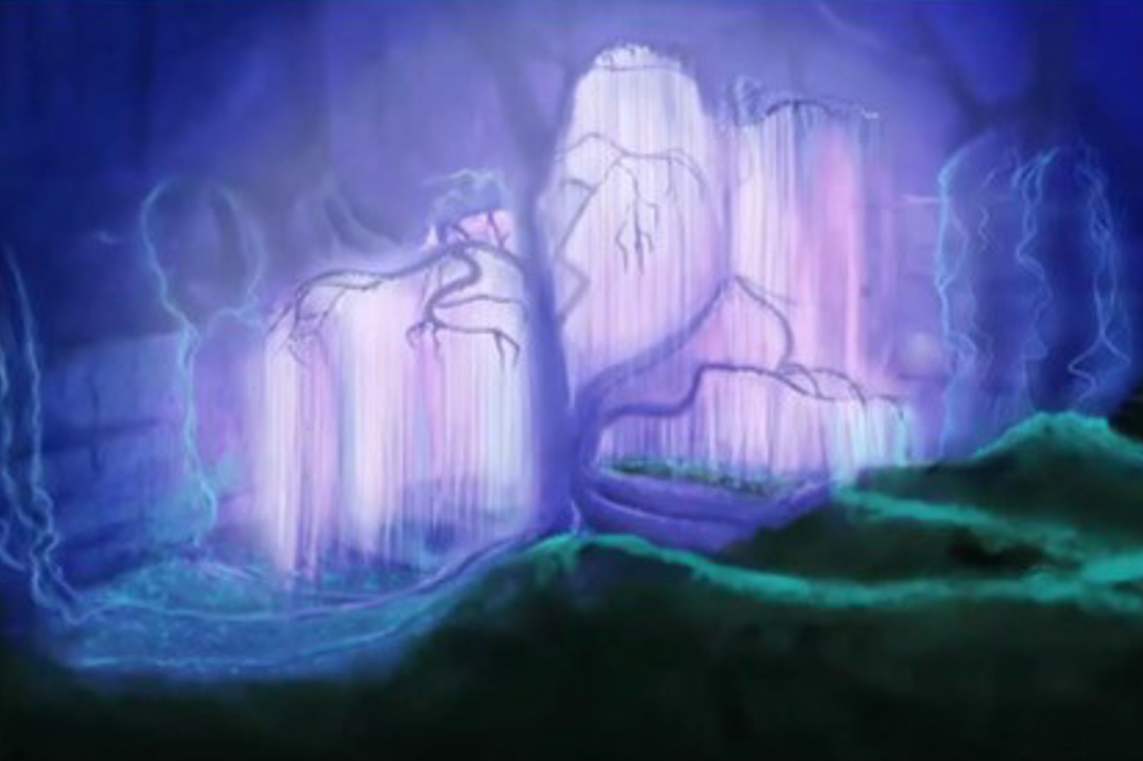
Avatar, the Tree of Souls, James Cameron
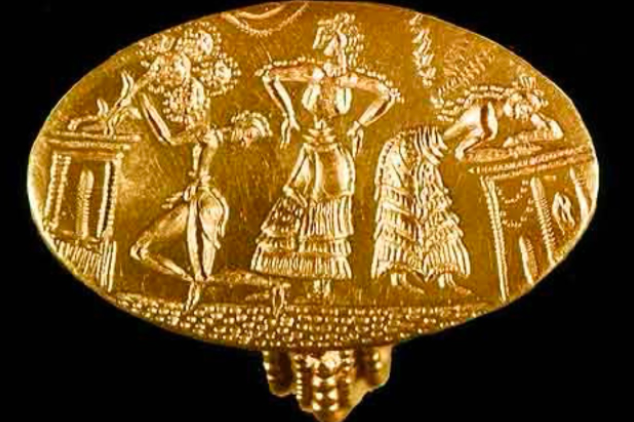
In this seal from 4000BC, the young god has ruptured the tree of life from the sacred altar and it’s too holy to look at, everyone is mourning, the priestesses clapping her sides in lamentation. Found in Herklion, Crete.
IV- The Science and the Mystery
We’ve come a long way in our understanding of trees thanks to science. Part of the connection we feel to trees can be traced back to the beginnings of the Plant Kingdom (500 million years ago). Primates showed up about 55 million years ago. Primates and humans have a DNA connection to plants. In fact, humans share about 25% of the DNA with that of a tree. So we’re all part tree.
Did you know that trees communicate with each other through their root system and the air? Their roots connect to a fungus in the soil called mycelium which acts as a telephone switch board communicating things to trees that influence their health like soil moisture and nutrient content. In return, the trees send the extra glucose of their photosynthesis down their trunks, out their roots and feed the mycelium in a symbiotic thank you cycle. Mycelia connect hundreds of trees in a vast communication network, sending information, food and water among them.
When a tree in a forest is attacked by a pest, it sends out a warning odor from its leaves. Neighboring trees absorb it and increase the production of pesticides in their leaves and bark in the hopes of warding off the invader.
Scientific studies have demonstrated that trees react to humans. My favorite involved two identical rooms. The researcher placed a fica tree in each. Each day he provided them with the same amount of light and water. In Room A, he piped in Mozart, Bach and other classical music, spoke lovingly, caressed its leaves, and read aloud Lady Chatterley's Lover. In Room B, he piped in 60’s punk and heavy metal and other acid rock music. He shouted and swore at the ficus and lunged at it, wielding a machete and threatening to chop it to smithereens.
In two short months, the growth of the Room A fica tree measurably outpaced the fica tree in Room B. In the 6th month, the researcher was found dead in Room B. He had become impaled on his machete. The machete’s handle was firmly stuck in the crook of a fica tree’s bough (I have exaggerated and added to this experiment for fun).
Today, scientific studies are connecting human health with the need to be in the presence of nature, namely trees, and in a forest.
Dr. Nooshin Razani, a pediatric infectious disease doctor offers “park prescriptions,” as a way to improve health for low-income children. Dr. Razani says. “We also have evidence that supports the mental health aspects of spending time in forests... Sometimes the doctors’ need is just as much as the patients’.”
So now what? Cutting down the trees brought sorrow into a beautiful experience of my life. I stumbled into this tree relationship thing, and it's still a mystery.
I want to stop feeling the unexpected pang of regret in the presence of magnificent trees. I encounter one such tree as I walk to my office. It’s
is a huge oak tree that lives on the lawn outside the Thoreau Center. I slow my walk to a stroll, then stop. I look up the massive trunk and follow the branches up to the sprawling canopy and leaves. My gaze falls on another branch and I follow the arch as it reaches all the way to the ground. Sadness fills me as I think about the chain saw slicing into the Big Fir.
Slowly I amble toward an opening in that leafy branch, where my head can fit through. I hear the wind rustle the leaves and feel them brush across my shoulder and head. I apologize for the death of his brother in Bohemia. Honestly, I feel the tree embrace me, and forgive me.
At least I didn’t do what Donald Currey did in 1964. He was a forester taking core samples of bristlecone pines that he would use to establish the age of the tree back in his lab. One day, in a particularly old and gnarled bristlecone, his coring tool got stuck. It was expensive, so he cut down the tree to remove it. He was shocked at the density and number of rings in the stump and began counting. It took hours. To his utter horror, he counted 4,800. He knew immediately that he had killed the oldest known living being on the planet. That mistake outraged the press and scientific community and it haunted him the rest of his life.
V- Conclusion
After 4 years on this topic, both a chasm and a bridge have appeared in me. I started this paper hoping to produce some relief from the grip of regret. I didn't know where my writing would lead me, but now I can see. I have learned two lessons.
The chasm is still there, that hole of longing, yearning to be taken back in time and redo the scene. And now, there is also a bridge that is carrying me to the other side. What is life if not a journey of learning how to accept our mistakes that we can not correct? If I can learn better how to accept the things I can not change back to how they were; if I can free up that time and energy that regretting sucks out of my life, then how much happier I will be! That’s lesson one.
The other lesson, is to become more mindful of what is really important to me before I do something that unwittingly destroys it. That requires self-knowledge. Even at the age of 65, I’m still learning to slow down, be more thoughtful, know myself. More meditation perhaps?
I must accept that I can never insulate myself from making painful mistakes. No one can. Making mistakes is an inevitable human condition.
So back to lesson one. The trick for me is to find a process of dealing with the regret my mistakes create and learning to let go. Writing this paper has sped up the process of building the bridge that my counseling began. So thanks to the club for giving me such a healthy focus! Now, just as the engineers do with the Golden Gate Bridge, let’s be sure I tend to the maintenance my bridge will require.
I’ll end with a quote attributed to Buddha, inscribed at the gate of a forest reserve at Kandy, Sri Lanka:
A tree is a wonderful living organism; it even gives shade to those who wield an axe to cut it down.
Thank you.
Bibliography
Buber, Martin. I and Thou. Walter Kaufmann (Translator), Charles Scribner’s Sons, Boston, 1970.
Eveleth, Rose. How One Man Accidentally Killed the Oldest Tree Ever.
Smithsonian.com, 2012 at: https://www.smithsonianmag.com/smart- news/how-one-man-accidentally-killed-the-oldest-tree-ever- 125764872/#1J3XTp7smV5jsXtl.99.
Haskell, George. The Songs of Trees. Penguin Books, New York, 2017. Pakenham, Thomas. Meetings with Remarkable Trees. New York, Random House, 1998.
Pakenham, Thomas. Remarkable Trees of the World. New York, W.W. Norton & Company, Inc., 2002.
Powers, Richard. The Overstory. New York, W.W. Norton, 2018. Razani, Nooshin, http://www.parkrx.org/.
Rommberg, Ami and Martin, Kathleen, Editors. The Book of Symbols. Cologne, Tachen GmbH, 2010.
Tompkins, Peter, and Christopher Bird. The Secret Life of Plants. New York: Harper & Row, 1973.
Wohlleben, Peter. The Hidden Life of Trees. California: Vancouver, Graystone Books, 2015.